Resident Thrum
Resident Thrum is an interactive installation that explores cardiac synchronization among two to six participants. Wearing heart rate monitors, players engage in a three-minute ritual on a hexagonal grid of seven plywood and acrylic haptic tiles. The system provides real-time multimodal feedback — haptic, sonic, and light — generated by participants' cardiac rhythms, nudging the group towards synchrony.
Premiered at ACM Creativity & Cognition 2026 (C&C '26), 13–16 July 2026, London, UK.
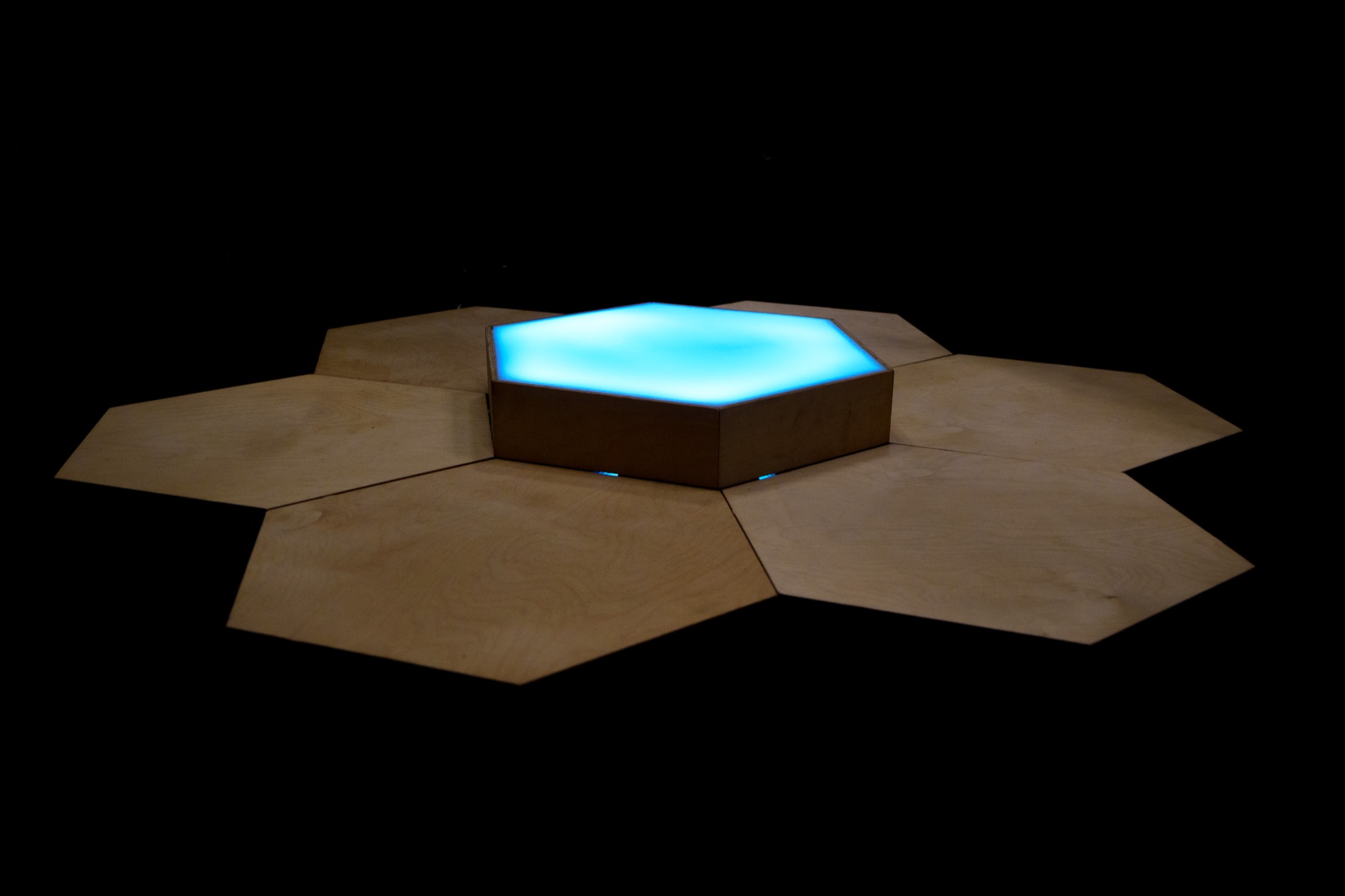
As synchronization improves, the soundscape becomes more harmonically resonant and light colors shift to warmer hues. This work integrates research on heart rate synchrony's relationship to prosocial behavior, creative cognition, and emotional regulation, creating an immersive experience that fosters social cohesion through group interoceptive coupling.
Embodied and Extended Cognition
The conceptual foundation for Resident Thrum draws from embodied and extended cognition research. Cognition is not confined to the brain but emerges through the body's continuous coupling with its environment. Recent studies demonstrate that heart rate synchrony predicts group consensus decisions with over 70% accuracy, suggesting that cardiac coupling may serve as a biomarker of shared attention and collective information processing. Interpersonal heart rate synchronization can also predict group cohesion, with increased cardiac synchrony corresponding to stronger feelings of connection among group members.
Resident Thrum makes cardiac synchrony both perceptible and goal-oriented. Participants become aware of their heartbeat's impact on group synchrony through haptic, sonic, and visual feedback, turning subconscious coordination into conscious collaboration. The installation aims to reveal the permeable boundaries of the individual self within a biological system of bodies.
Social Rituals
The piece employs a ritual framework to achieve what Victor Turner called communitas: the feeling of social equality and togetherness that emerges when ordinary hierarchies are suspended and participants encounter one another as fellow beings. The ritual within Resident Thrum supports interpersonal coupling at the level of the autonomic nervous system through three deliberate stages: the threshold, when players don heart rate monitors and step onto the hexagonal grid; the bounded three-minute duration; and the facilitated reflection that concludes each session.
Vibration as Social Signal
The hexagonal geometry of the haptic grid references the honeycomb structure of beehives, built through collective labor and associated with the waggle dance through which bees communicate spatial information via bodily vibration. This metaphor grounds the installation's visual design: like bees, humans transmit information through bodily expression, though the cardiac channel typically operates below conscious awareness. The installation makes the physiology of the group tangible through oscillating vibration and light.
Premiere at Creativity & Cognition 2026
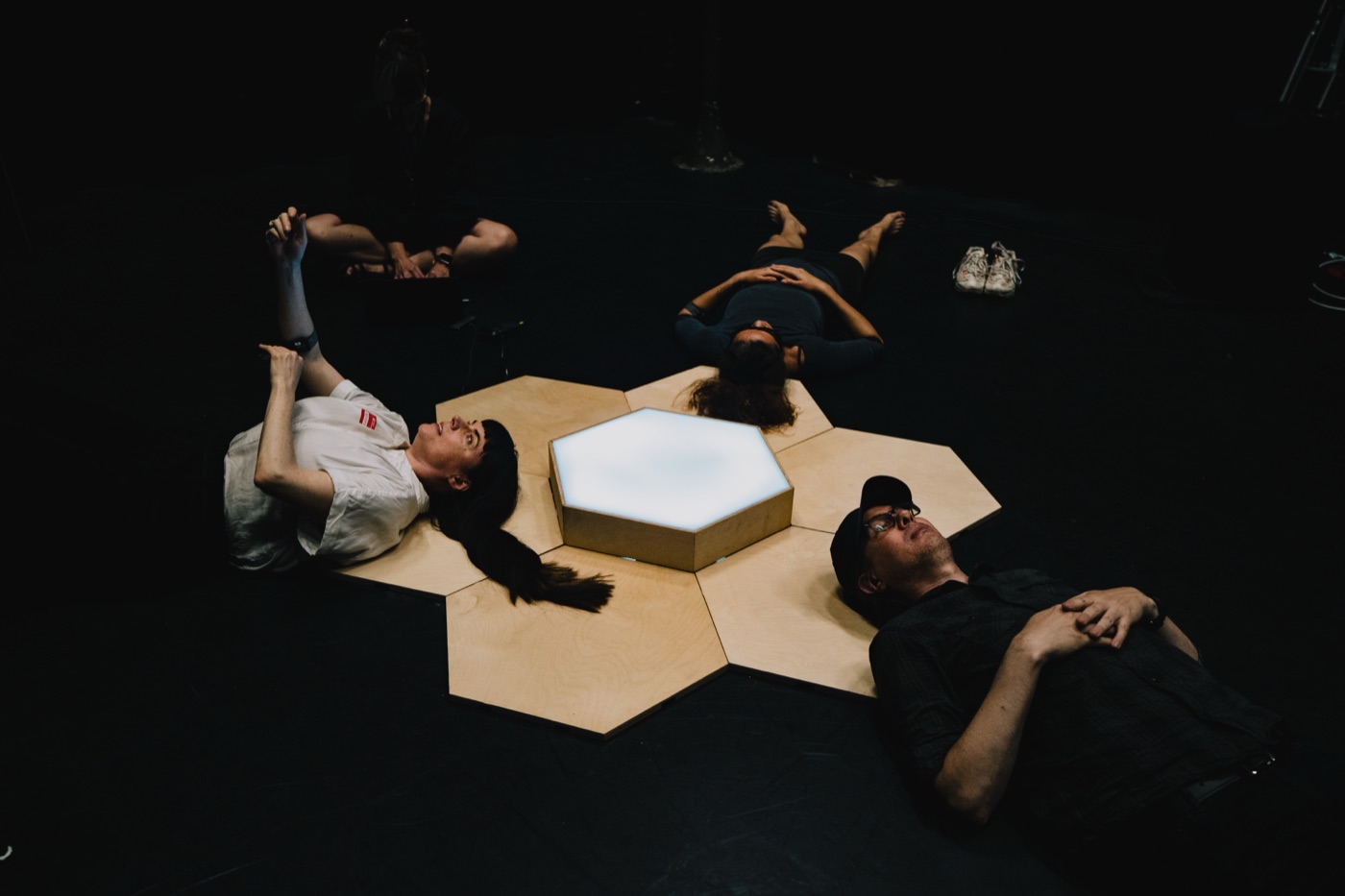
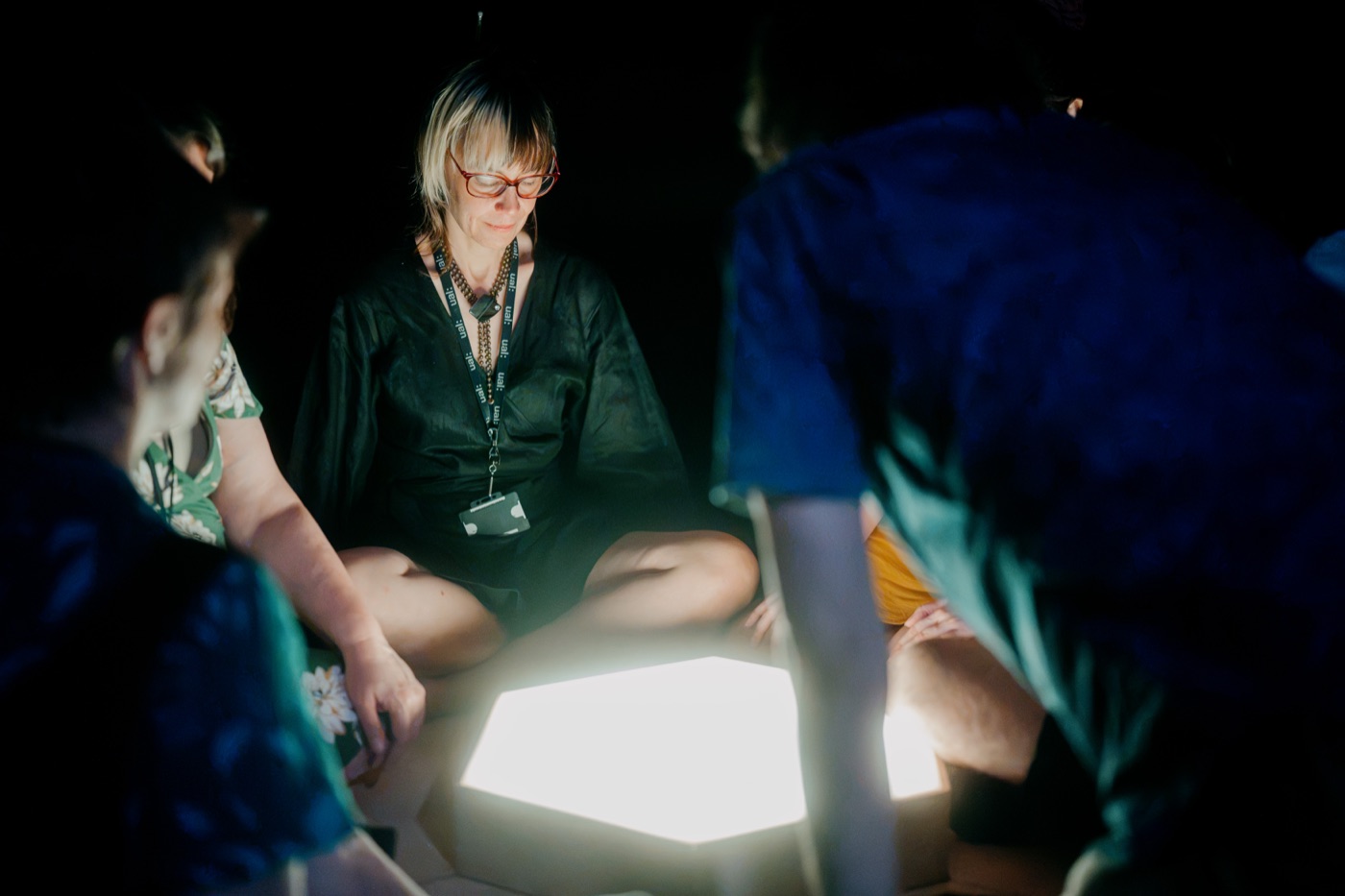
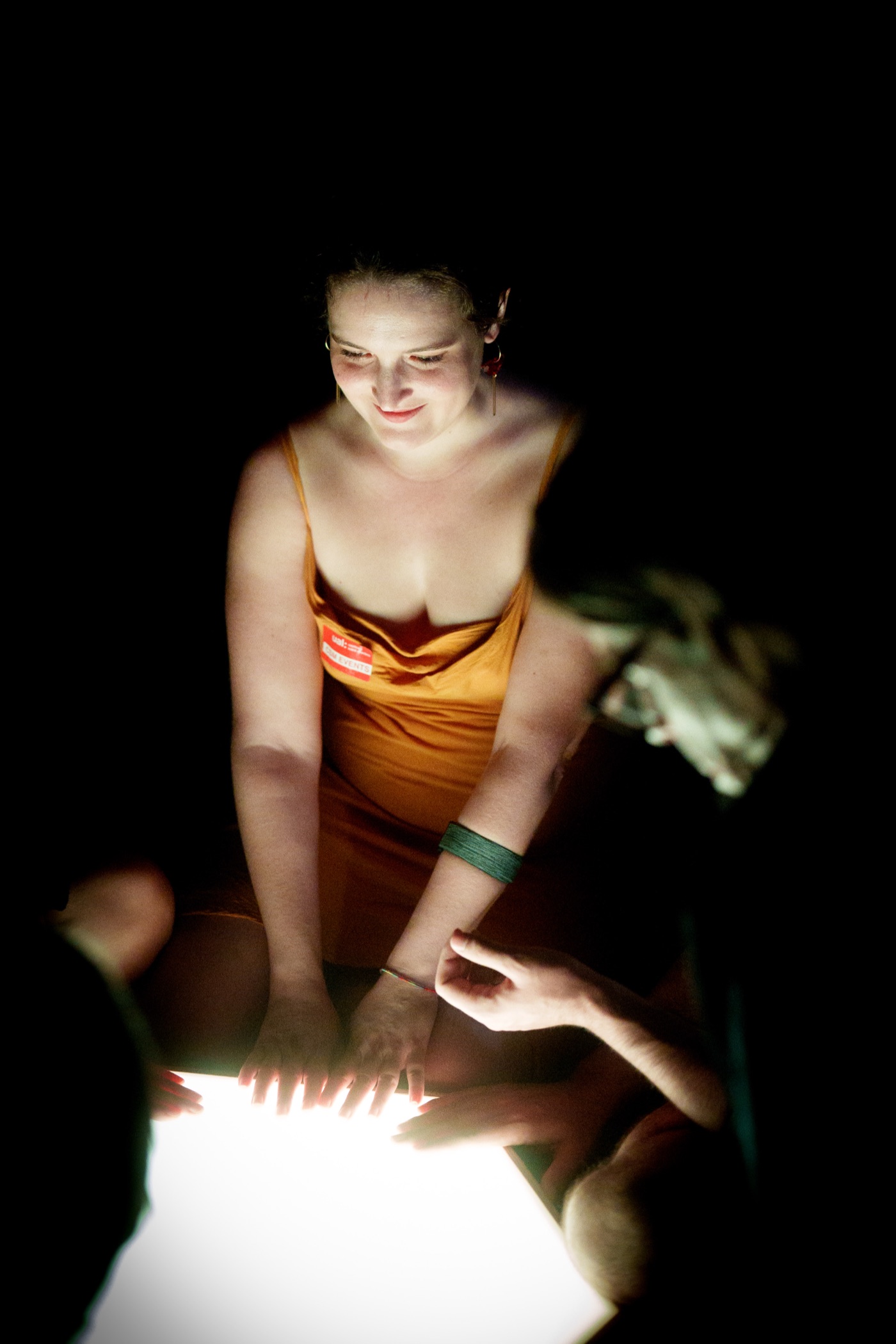
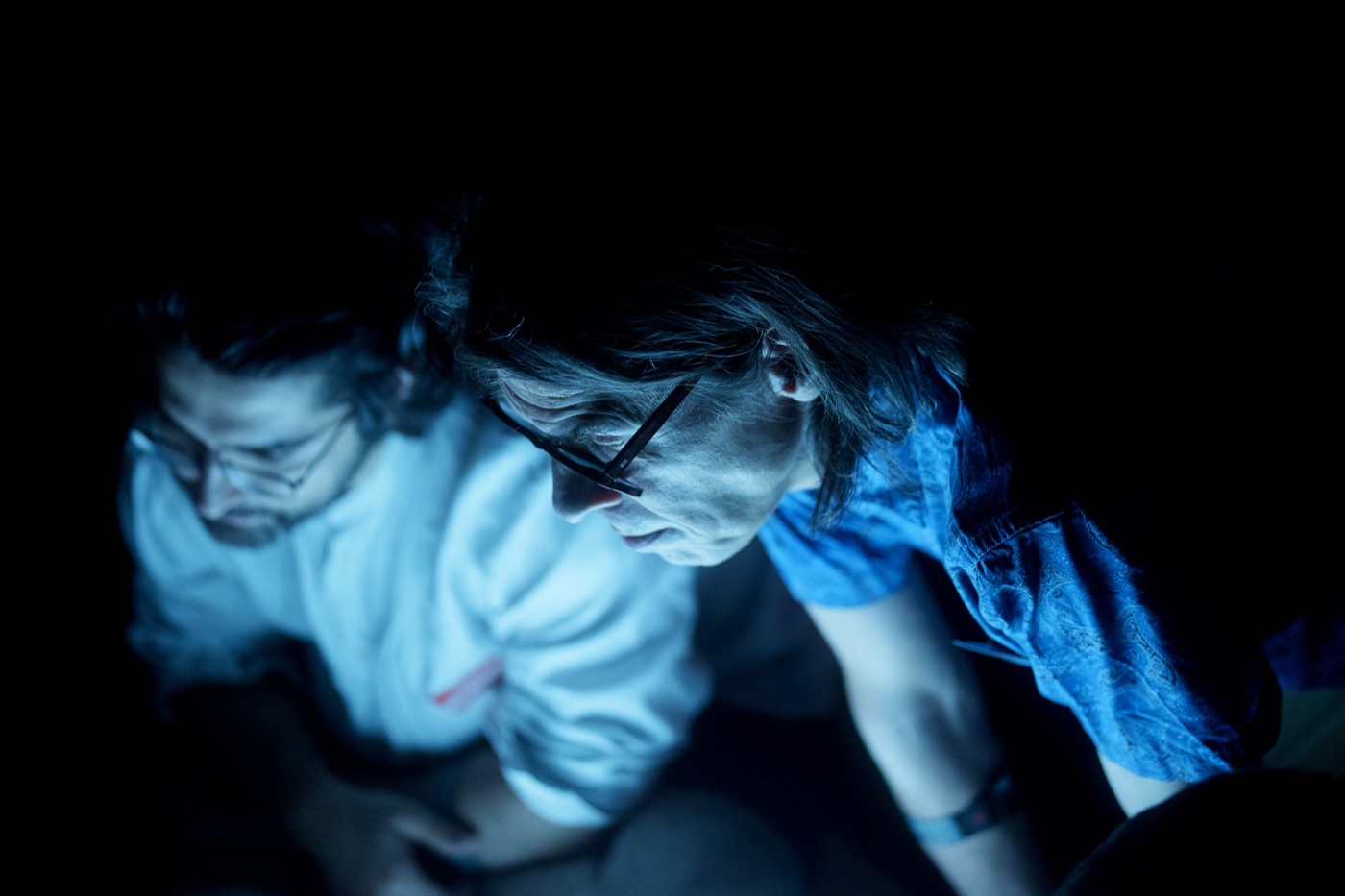
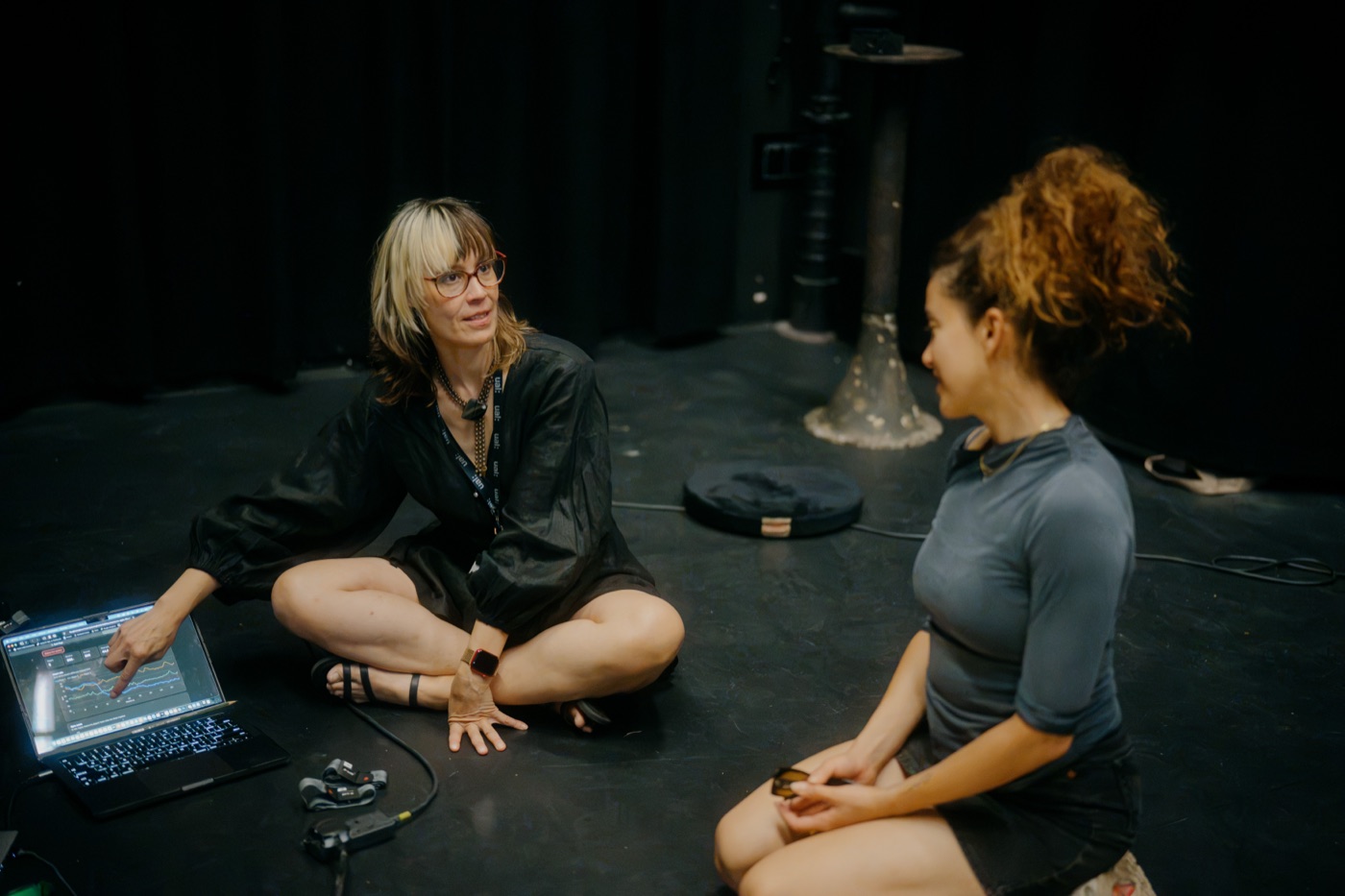
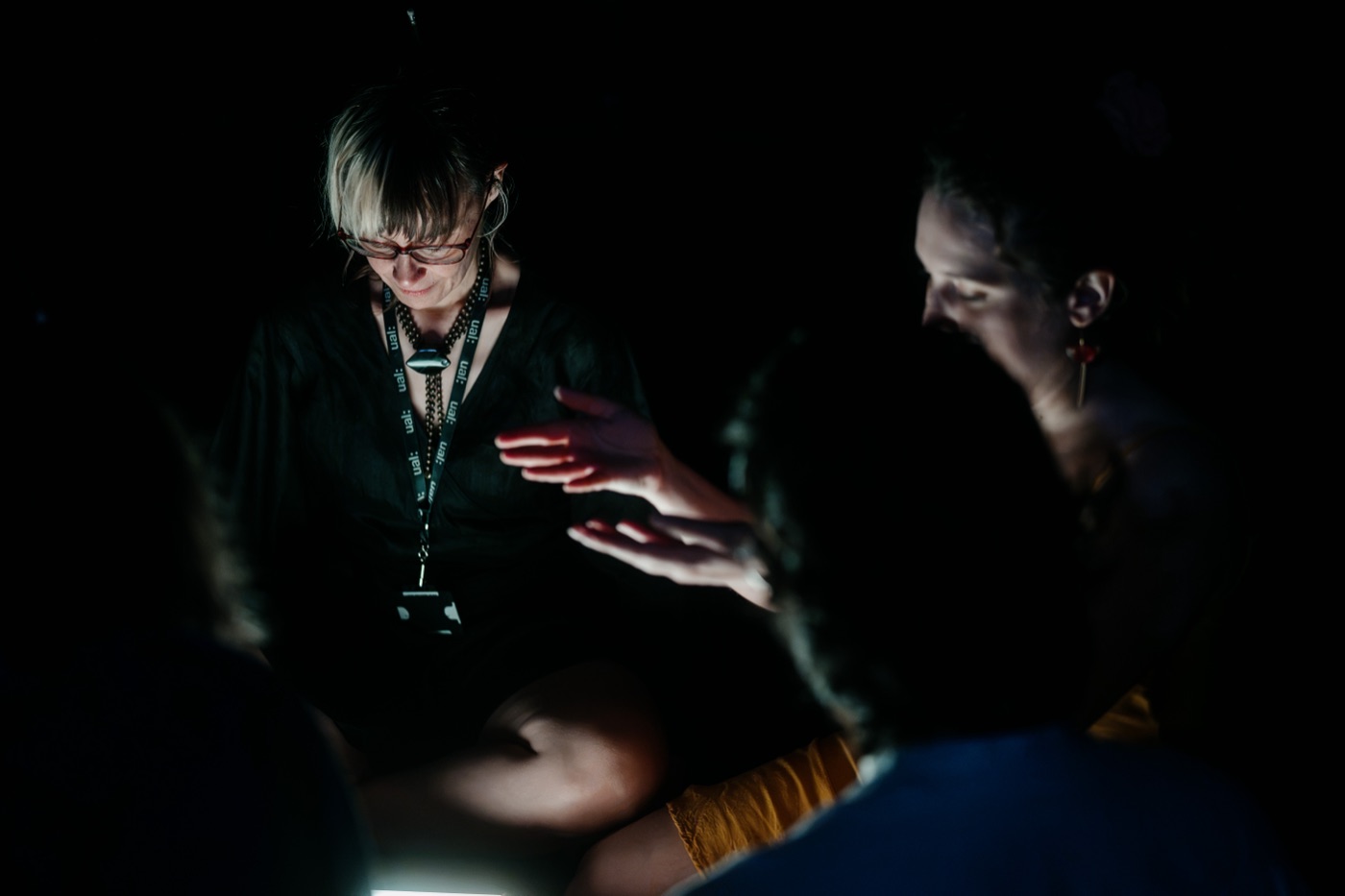
Resident Thrum premiered at ACM Creativity & Cognition (C&C '26) in London, 13–16 July 2026. Over the run of the show, groups of strangers sat the three-minute ritual together — lying down, breathing, and watching the central tile warm as their heartbeats drew closer. A convener fitted the monitors, guided each session, and led a short reflection afterwards. The photographs below are from that exhibition.
Curate Resident Thrum
Resident Thrum is available for exhibition. Below are the technical details for curators and venues considering hosting this installation.
System Architecture
The system comprises three layers designed for real-time multimodal feedback with minimal latency.
Sensing Layer
Participants wear Polar heart rate monitors with a choice of form factors: the OH1+ optical armband, H9 chest strap, or Loop wristband. This flexibility accommodates different comfort preferences, which matters for a work concerned with bodily awareness. Monitors connect via Bluetooth to the processing layer.
Processing Layer
A Mac laptop runs custom desktop software that aggregates incoming heart rate data. Synchronization is calculated using a range-based algorithm: the system identifies the maximum and minimum heart rates among all connected participants and computes the difference. A range of zero indicates perfect synchrony and corresponds to a sync score of 100%. This computationally lightweight approach produces an intuitive, responsive metric appropriate for artistic contexts prioritizing felt experience over clinical precision.
Physical Output Layer
An ESP32 microcontroller receives synchronization and individual heart rate data via Bluetooth and controls the physical outputs. Each wooden tile contains a precision haptic motor mounted to its underside, producing vibrations synchronized to the seated participant's heartbeat. The central hexagonal tile features a white acrylic surface with six internal LED strips — one for each potential participant — that shift from cool to warm tones as group synchrony increases.
Sonic Output Layer
OSC messages route from the desktop application to Max/MSP. Max for Live maps incoming data to musical parameters: synchronization level modulates the tempo of a rhythmic layer and the frequency of a harmonic pad. As sync increases, rhythmic elements cohere and harmonic tones warm, creating an audible reward for collective convergence.
Installation Requirements
Space: Floor area for the hexagonal grid of 7 plywood tiles (6 participant tiles + 1 central acrylic tile). The grid accommodates 2–6 seated participants.
Power & Equipment: Standard power outlets and table space for a Mac laptop. PA system or speakers for sonic output. Heart rate monitors are provided with the installation.
Session Format: Each session runs approximately 3 minutes, followed by a short facilitated reflection. A ritual convener guides participants through the experience.
Staffing: One facilitator per session to manage heart rate monitor fitting, guide the ritual, and lead post-session reflection.
Research
Resident Thrum functions as both an artistic output and an active research site. The work employs an exhibition-led design methodology where each public showing generates data that directly informs subsequent iterations. The research investigates whether technologically mediated awareness of group cardiac activity generates a subjective sense of collective embodiment, how participants interpret the experience affectively, and how making typically subconscious interoceptive signals conscious alters understanding of social connection.
Data collection combines heart rate logging with facilitated post-session reflections, enabling correlation between physiological synchronization patterns and subjective participant reports. Through iterative cycles of public engagement and design refinement, this research aims to contribute transferable knowledge to the design of group interoceptive interactions in immersive contexts.
Publication & Open Source
The work is documented in a peer-reviewed paper, Resident Thrum: Designing for Group Cardiac Synchronization through Multimodal Biofeedback (Phoenix Perry, Creative Computing Institute, University of the Arts London), published in the Proceedings of ACM Creativity & Cognition 2026. Read the paper — DOI: 10.1145/3803784.3809264.
The hardware and firmware are open source. thrum-hardware holds the ESP32 firmware, haptic drivers, and LED control for the tiles.
Interested in exhibiting Resident Thrum?
If you are a curator, festival organizer, or venue interested in hosting Resident Thrum, please get in touch.
Get in Touch